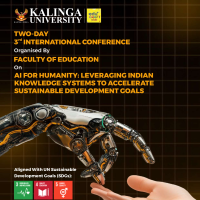
International Conference on AI for Humanity: Leveraging indian knowledge systems to accelerate sustainable development goals
Filed by Kalinga University, Raipur
- Dates
- 14 Jun 2026 - 30 Aug
- Place
- Online / Virtual · Online
- Source
- Unstop
Dispatch
Mode: Hybrid22-23 January 202710:00 A.M. TO 04:00 P.M.KALINGA UNIVERSITY, KOTNI, NEAR MANTRALAYA, NAYA RAIPUR - 492101, CHHATTISGARH, INDIA About Kalinga University: Kalinga University, Established in 2013, Stands out As One of The Leading Private Universities Strategically Located in The Smart City of New Raipur, Chhattisgarh. the University Has Consistently Ranked Among the Top 101–150 Universities in India Under the Nirf Rankings 2025 for The Fourth Consecutive Year and Has Also Received a Naac B+ Accreditation, Continuously Shining on The Horizons of High-Quality Education. About the Faculty of Education: The Faculty of Education at Kalinga University, Naya Raipur, Is a Beacon of Knowledge and Innovation. with A Team of Highly Qualified and Experienced Faculty Members, It Offers Comprehensive and Industry-Aligned Programs for Aspiring Educators. the Department Focuses on Not Just Theoretical Knowledge but Also Practical Application Through Internships and Hands-On Experiences. Kalinga University's Faculty of Education Instils in Its Students a Passion for Teaching, Equipping Them with The Skills and Expertise Needed to Excel in Their Careers and Make a Meaningful Impact in The Field of Education. Call for Papers: The International Conference on Ai for Humanity: Leveraging Indian Knowledge Systems to Accelerate Sustainable Development Goals, Organised by The Faculty of Education, Kalinga University, Naya Raipur, Will Be Held on 21 & 22 January 2027. the Conference Invites Contributions in The Form of Full-Length Scholarly Papers Documenting Original and Substantial Research Work. Theme: Ai for Humanity: Leveraging Indian Knowledge Systems to Accelerate Sustainable Development Goals The Theme Ai for Humanity: Leveraging Indian Knowledge Systems to Accelerate Sustainable Development Goals Envisions a Transformative Dialogue Between Cutting Edge Artificial Intelligence and The Timeless Wisdom Embedded in India's Intellectual Traditions. Rooted in Holistic Principles Such as Vasudhaiva Kutumbakam (the World As One Family), Harmony with Nature, Ethical Responsibility, and Community-Centred Living, Indian Knowledge Systems (iks) Offer Sustainable Models in Health, Agriculture, Education, Governance, and Environmental Stewardship. by Integrating Ai-Driven Analytics, Predictive Modelling, and Digital Innovation with Traditional Practices Like Ayurveda, Indigenous Agricultural Methods, and Value-Based Education, This Conference Seeks to Explore Inclusive and Culturally Grounded Solutions for Achieving the Sustainable Development Goals (sd Gs). the Theme Emphasises that Technological Advancement Must Align with Human Values, Social Equity, and Ecological Balance. It Calls upon Scholars, Policymakers, Technologists, and Educators to Collaboratively Design Ai Systems that Are Ethical, Sustainable, and Rooted in Indigenous Knowledge, Thereby Accelerating Progress Toward a Resilient, Equitable, and Sustainable Global Future. About the Theme: Ai-Enabled Teaching–learning Practices Integrating Indian Knowledge Systems (iks) Ai for Inclusive, Equitable, and Quality Education (sdg 4) Digital Gurukul: Reimagining Traditional Indian Pedagogies Through Ai Ai in Curriculum Design Aligned with Indian Epistemology Teacher Readiness, Professional Development, and Ai Literacy Personalised Learning Using Ai and Indigenous Learning Principles Ethical and Human-Centred Ai in Education Ai for Multilingual Education and Preservation of Indian Languages Sub-Themes: Education, Teacher Education & Pedagogy: Human-Centred Ai Design Inspired by Indian Philosophical Foundations Ai for Sustainable Infrastructure and Smart Villages Indigenous Engineering Knowledge and Modern Ai Applications Robotics and Automation for Social Good Ai and Green Technologies for Environmental Sustainability Explainable and Ethical Ai Based on Indian Ethical Frameworks Ai and Industry 5.0: Human–machine Collaboration Ai Innovations for Disaster Prediction and Management Engineering, Technology & Innovation: Ai Integration with Ayurveda, Yoga, and Traditional Medicine Predictive Healthcare Using Ai and Indigenous Healing Knowledge Mental Health, Wellbeing, and Ai-Based Interventions Ai in Preventive and Community Health Systems Digital Health Equity and Rural Healthcare Access Ai-Supported Diagnosis Using Traditional Symptom Classification Systems Integrating Holistic Indian Wellness Models with Ai Health Sciences, Yoga & Wellbeing:1. Ai for Sustainable Agriculture Using Traditional Farming Knowledge2. Indigenous Ecological Knowledge and Ai-Based Climate Adaptation3. Precision Agriculture Inspired by Traditional Indian Practices4. Ai for Tribal Livelihood Enhancement and Empowerment5. Sustainable Food Systems Combining Ai and Indigenous Biodiversity Knowledge6. Ai-Based Water Conservation Using Traditional Indian Methods7. Smart Rural Ecosystems and Ai-Enabled Village Development Agriculture, Rural Development & Tribal Knowledge:1. Ai and Preservation of Indian Cultural Heritage2. Ai for Documentation and Revitalisation of Indigenous Knowledge3. Ethical Frameworks of Ai Based on Indian Philosophy (dharma, Nyaya, Etc.)4. Ai, Society, and Human Values: Indian Perspectives5. Ai for Social Justice, Equity, and Inclusion6. Cultural Intelligence and Ai7. Ai and Digital Humanities Social Sciences, Humanities & Cultural Studies: Ai for Sustainable and Ethical Business Practices Indian Management Principles and Ai Leadership Models Ai for Social Entrepreneurship and Sustainable Enterprises Ai-Driven Innovation Ecosystems Ai for Financial Inclusion and Rural Economic Development Circular Economy and Sustainable Production Through Ai Ai and Responsible Organisational Governance Management, Commerce & Economics: Ai for Climate Change Mitigation and Adaptation Traditional Ecological Knowledge and Ai Solutions Biodiversity Conservation Using Ai and Indigenous Practices Ai for Natural Resource Management Ai-Based Environmental Monitoring Systems Sustainable Urban Planning Inspired by Traditional Indian Models Environmental Sciences & Sustainability: Ethical Governance of Ai Using Indian Ethical Traditions Ai Policy Frameworks for Sustainable Development Legal Implications of Ai in Human Society Ai and Data Protection: Ethical Perspectives Ai for Transparent and Accountable Governance Indigenous Knowledge Protection and Intellectual Property Law, Policy & Governance: Ai and Preservation of Indian Art, Music, and Literature Ai-Generated Art and Indian Aesthetic Theory Digital Storytelling and Indigenous Narratives Ai for Cultural Preservation and Promotion Fusion of Traditional Arts and Ai Technologies Arts, Literature & Creative Fields: Ai for Achieving Sd Gs Through Indigenous Wisdom Human-Centred Ai Inspired by Indian Philosophy Ai and Spirituality: Consciousness and Cognition Ai for Sustainable Community Development Integrating Modern Science with Indian Knowledge Systems Future of Humanity: Ai, Ethics, and Indian Civilizational Wisdom Awards: Certificate/e-Certificate Will Be Provided to Every Participant Other Selected Papers Will Be Published in An Edited Book with An Isbn Number/scopus Journal Conference Souvenir Will Be Released at The Inauguration of The Conference Note: the Author Has to Pay the Fee for The Publication in The Journal a Soft Copy of The Book/proceedings Shall Be Provided to The Authors Hard Copy Will Be Provided on Request with Applicable Charges Accommodation Within Campus: Accommodation Will Be Provided only To Participants from Outside Raipur at A Cost of Inr 800/- per Day No Ta/da Will Be Provided to The Participants by The Organisers Registration & Payment Details: Registration Fee: Inr 1500/- Registration Fee for Mo U Institutes, Kalinga University Students and Faculties: Inr 750/ Submission Guidelines: Abstract Submission: An Abstract May Have a Maximum of 300 Words and A Maximum of 5 Keywords E-Mail Abstract and Full Papers At: Education.Conferences@kalingauniversity.Ac.In the Length of The Paper Should Be Between 3000 and 5000 Words the Full Paper Must Be Formatted as An Ms Word Document in Times New Roman, 12-Point Font Size Registration Is Compulsory for All the Participants, Authors and Co-Authors with The Transaction Id Number and Payment Receipt in Pdf Format Registration without A Transaction Id Number and Payment Receipt Will Not Be Considered All Registered Participants Will Be Given E-Certificates No Abstract or Full Paper Shall Be Accepted After the Last Submission Date only The Selected Abstracts Will Be Permitted for Presentation Co-Authorship Is Permitted, and At Least One Author Must Attend the Conference to Present the Paper All Submissions Must Be the Author's Original and Unpublished Work Similarity Should Not Be More than 10% Important Dates: Last Date of Submission of Abstract:15 December 2026 Notification of Acceptance of Abstract: 20 December 2026 Last Date of Early Bird Registration: 30 December 2026 Last Date for Registration and Payment Submission of Full Paper: 10 January 2027 International Conference: 21 & 22 January 2027 Publication Opportunities: All Accepted Papers Will Be Published in The Conference Proceedings with An Isbn, Released at The Time of The Event Selected Peer-Reviewed Papers Will Be Published in A Reputed Peer-Reviewed Journal (publication Charges Apply) Additional Selected Papers Will Be Considered for An Edited Volume (isbn) with An International Publisher (publication Charges Apply) All Submissions Will Undergo a Peer-Review Process by An Expert Academic Committee
#unstop #conference #conferences #online #ai research #artificial intelligence (ai) #research skills #education compliance #education law #undergraduate #postgraduate #engineering students #management #arts, commerce, sciences & others #law #medical